
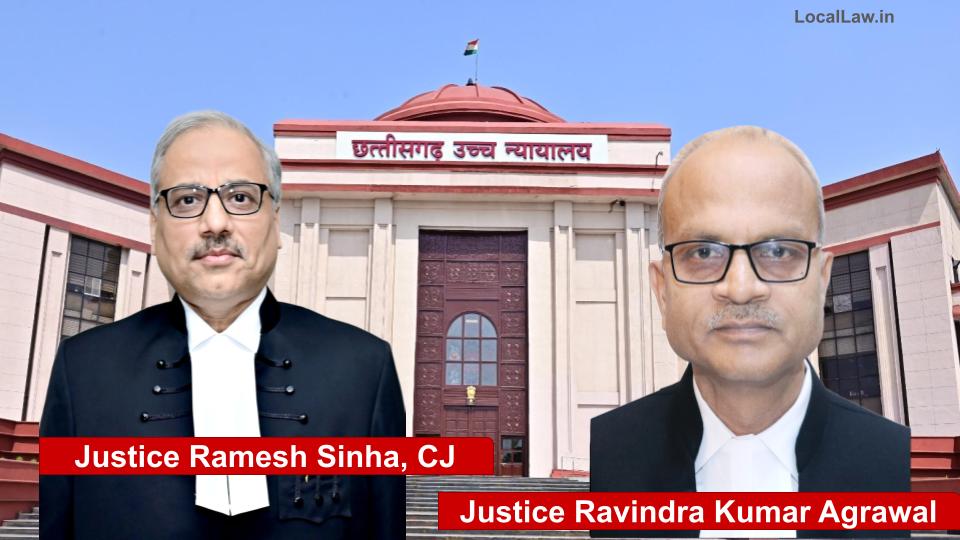
Bilaspur : The High Court of Chhattisgarh has upheld the conviction and 15-year sentence of a Raipur resident in a narcotics case, holding that the prosecution proved possession of contraband and that alleged procedural lapses did not weaken the case. A Division Bench of Chief Justice Ramesh Sinha and Justice Ravindra Kumar Agrawal dismissed the appeal filed by Sheikh Rehman Qureshi, who had challenged his conviction under Section 22(c) of the Narcotic Drugs and Psychotropic Substances Act, 1985 (NDPS Act).
The case arose from a police operation on May 4, 2024, after officers received specific information about drug activity near the Kashiram Nagar overbridge in Raipur. Acting on the tip-off, the police team intercepted the accused and recovered 600 capsules of Spasmo Proxyvon Plus from a bag he was carrying. Forensic examination later confirmed that the capsules contained psychotropic substances including Tramadol, Dicyclomine and Acetaminophen.
The trial court found the accused guilty and sentenced him to 15 years of rigorous imprisonment along with a fine of ₹1.5 lakh. Challenging this, the appellant argued before the High Court that the prosecution case was vitiated by serious procedural lapses. His counsel claimed that mandatory safeguards under Sections 50, 52A and 55 of the NDPS Act had not been followed, that the sampling process was defective, and that gaps in the chain of custody and delays in forensic examination cast doubt on the integrity of the evidence.
The State opposed the appeal, arguing that the recovery, seizure and forensic confirmation were properly established and that minor discrepancies did not affect the credibility of the prosecution’s case. It maintained that the evidence clearly showed conscious possession of contraband by the accused.
After reviewing the record, the High Court rejected the defence arguments and upheld the conviction. It held that the recovery from a bag carried by the accused did not amount to a personal search, and therefore the safeguards under Section 50 of the NDPS Act were not applicable. The Court also noted that the seizure took place in a public place, bringing the case within the scope of Section 43 of the Act, where stricter requirements applicable to private searches do not apply in the same manner.
On the issue of procedural compliance, the Court found that there was substantial adherence to legal requirements. It observed that the seizure was properly documented, the samples were duly drawn and sent for forensic analysis, and the chain of custody remained intact. Relying on settled Supreme Court principles, the Bench held that minor procedural irregularities cannot invalidate a conviction unless they create serious doubt about the recovery or cause prejudice to the accused.
Concluding that the prosecution had proved conscious possession beyond reasonable doubt, the High Court dismissed the appeal and affirmed both the conviction and sentence.
Case Title : Sheikh Rehman Qureshi vs State of Chhattisgarh (CRA No. 2151 of 2025)